
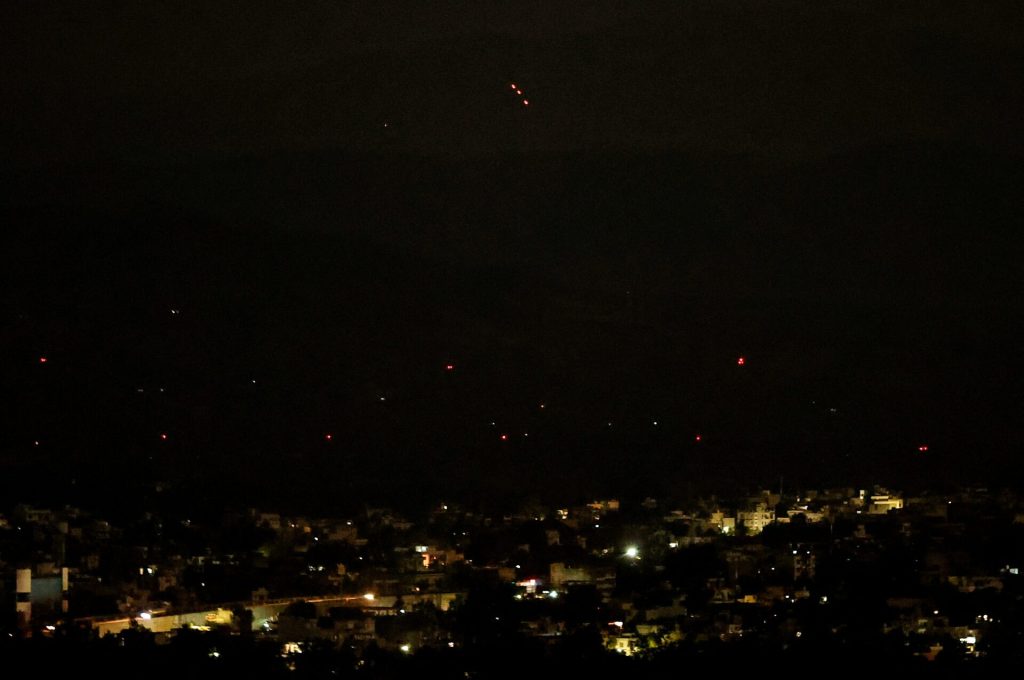
The city of Jammu, Indian air defences are intercepting attacks
According to a Reuters report, blasts were heard in Srinagar and Jammu today (10.05.2025). Projectiles and flashes were also seen in the night sky over Jammu.
Earlier today, both countries celebrated their agreement to stop all fighting today at 5 pm Indian time. The US apparently took centre stage in these talks and were “pleased to announce” the cease fire, saying: “Congratulations to both Countries on using Common Sense and Great Intelligence.”
Both sides were quick to issue statements on their the diplomatic efforts, which didn’t exactly inspire confidence in the longevity of the agreement. These statements – while focusing on peace and stability – also emphasised the uncompromising stances on both sides. The Pakistani Foreign Minister Ishaq Dar posted on X: “Pakistan has always strived for peace and security in the region, without compromising on its sovereignty and territorial integrity!” The Indian external affairs minister S Jaishankar said that “India has consistently maintained a firm and uncompromising stance against terrorism in all its forms and manifestations. It will continue to do so.”
The legitimacy of the agreement was furthermore undermined by the revelation that neither side would lift the punitive measures, such as trade suspension and visa cancellations, from one another. More crucially, sources have told Reuters that the 1960 Water Sharing Treaty between the two nations was still suspended. This treaty ensured Pakistan’s ability to use the water from the Indus River unimpeded – the river has its source in India, which could theoretically obstruct Pakistan’s ability to use the water. As Pakistan is highly dependent on the Indus River for hydropower and irrigation, this treaty was felt to be a linchpin for stability in the region. The continued suspension of it is the Achilles heel of any proposed truce.
With these caveats undermining the truce, tensions escalated once more in the region of Kashmir (India).
Oddly enough, this seems to somewhat mirror what we have observed recently in the Ukraine and Israel, where other ceasefires had been announced, only to fall apart within days. The US took a leading role in these negotiations too.
The common denominator in these cases is that all respective agreements seemed to lack any kind of commitments, compromises and – most crucially – guarantees. No enforcements, no observers, no consequences to breaking the truce for either side of any of these conflicts. Economic sanctions, for example, are tried and tested tools for situations like these. There were no incentives either – nothing any side could gain from holding to a truce. Third party mediators could come in and help define what these carrot-and-stick scenarios could look like. But, unfortunately, this has not happened, which made any ceasefire little more than a handshake-agreement.
Written by the PFP editors
Last edited: 10.05.2025, 22:50 pm GMT
 Pericles Foreign Policy